
By Kaila Sewer
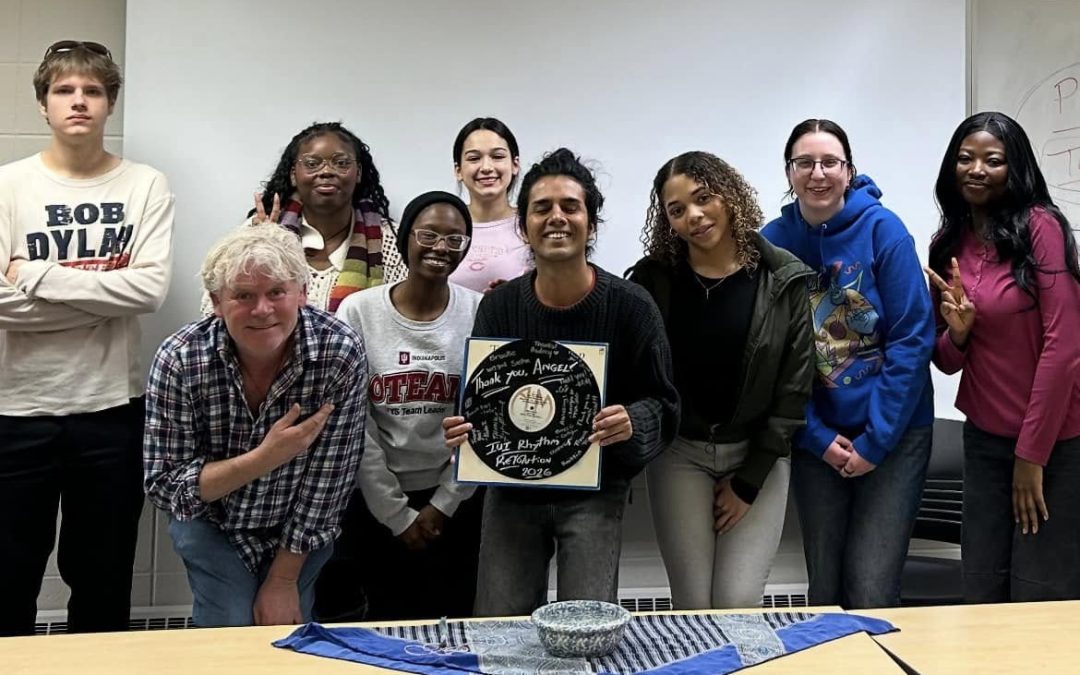
Jorge Poveda Yánez (Angel), moves, like water, through disciplines. An artist and scholar shaped by both performing arts and science, his work rebuffs categorization. Angel joined our IU Indianapolis “Rhythm and Revolution” class in February, 2026, giving a lecture-performance that included water drums featured in much of the Yaqui Indigenous Culture’s ceremonies. As I reflect on the performance, a line – shared from Angel – frames much of what follows: “Here, I am interested in highlighting how different technologies (digital or ancestral) imply different perceptual experiences of speed and rhythm, mostly lived through music and dance.”
The room is quiet as Angel begins: the low pulse of Yaqui water drums. Unlike conventional western percussion, water rums breathe air into the room. For me, an uninformed viewer and listener, the drums are disorienting – but not in a bad way. The sound is immersive, internal, as if the body is remembering something long forgotten. This is where the quote returns.
This ancestral technology is not abstract. It produces a different rhythm that reshapes experience. This sensory encounter leads towards a proposition from Angel: water is who we are. He asks himself, “How am I in dialogue with other forces, which in this case, to me, is a beautiful metaphor and reality simultaneously?” We turn then to another idea, based primarily on water as a form of intelligence. Angel states that “I’m thinking of how, in the context of computational technology, intelligence is only measured in terms of the amount of calculations that are devised that a computer can do inside of it, but from [the way] we grapple with intelligence through the perspective of water, what we should really be measuring in terms of how intelligent any system is, is how compatible it is with water and all the rest of the natural portions that we have.”
Water is not artificial, but it is a responsive and adaptive aspect of being. It carries and it transforms. Through this lens, intelligence isn’t confined to ones and zeros, but something ecological that we participate in, not control.
Angel poses yet another question: What is a song beyond its lyrics? What is the drum if you are not there to feel it? It was then that I realized that the water drum isn’t just something to hear but something I am meant to feel. Music, in this case, is meant to touch the senses.
Does song, then, need lyrics to carry meaning? No. Th meaning arises through vibration and presence rather than words. What happens when such things are digitized? Recording preserves the tone, but something shifts within. The physicality and shared space become flat.
The digital drum still beats, but it doesn’t feel. Rhythms become more controlled and less alive. The water drum, then, aligns oneself with a living network. It was explained that what we experienced was part of Hikuri ceremony from the Yaqui community in which 4 different songs are offered for the elements in effort to bless the four directions.
By the end, I left with more questions than anticipated. Angel doesn’t aim to offer conclusions but invites us to listen differently. To reconsider how we define knowledge, how we recognize technology, and how it shapes what we hear. He asks us to think and feel. Beneath the theory, though, the water remains.