
Words by Audrey Parker and Tanya TL. Nichols
By Audrey Parker
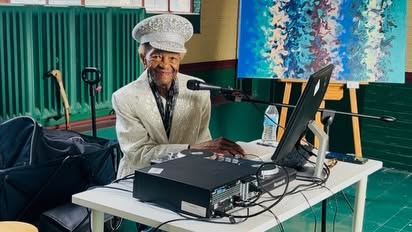
If you have ever felt moved by Motown, a conversation with Herman “Butch” Slaughter would be nothing short of a dream! Butch Slaughter is a veteran in the music industry and a passionate advocate for his roots. He recently shared his thoughts on the intersection of music, social change, and the enduring power of funk on campus at IU Indianapolis. Slaughter says that funk is more than entertainment. Music is the heartbeat of a community and a big driver of societal change. As he said during his visit, “Motown was the most influential in social change, like…past or present.”
Slaughter saw firsthand the culture that used to define the city’s music scene, as he grew up in Indianapolis (or a place affectionately known as “Naptown.”). However, he has noticed that this community is currently at risk. Many of his current projects involve efforts to revitalize this dying music culture and restore the visibility of local artists. Slaughter’s thoughts are supported by fellow musicians Gary Amos and Sasha Ridle, who describe Slaughter as a “walking encyclopedia” of musical knowledge. Gary Amos is a fellow band member and close friend of Slaughters. He is a legendary funk bassist and learned alongside Slaughter from a young age (19!). Amos provided a great framework for Slaughter’s projects, and suggested that “artists are manipulated by the time… artists are created by society and social change.” This philosophy spells out Slaughter’s career. He views the artist not just as a performer, but as a storyteller who documents the struggles and aspirations of their era.
Slaughter has not gone through his journey without significant challenges, particularly involving the use of intellectual property. He talked about how major labels and producers would often undermine local talent. They sometimes even sold ideas and samples to hip-hop artists without providing proper credit or compensation to the original creators. He spoke to the difficulty of “the little guy” and what they face when pitted against industry titans. He said, “Nobody’s going to take your case… Nobody wants to fight Universal.” He also told the class about a time when record labels would steal ideas off of records, and then burn them. This meant that the labels got all the credit and royalties from smaller artists’ ideas, and left no evidence of the theft.
Despite these hardships, Slaughter’s devotion to funk remains steadfast. He argued that funk is the foundational music that paved the way for R&B, jazz, and gospel. For his friend, Gary Amos, the genre is defined by its rhythm: “Funk is what involves a beat. Drums change the music.” Past the groove of the sound, Slaughter celebrated funk for its historic role in empowering underrepresented groups, including women, minorities, and the LGBTQ+ community in times when they were otherwise marginalized.
A central and final theme of the class’ conversation with Slaughter was the restoration of community through “third spaces,” or physical venues. Sasha Ridle, our third guest speaker, was a big part of this discussion. Sasha is a graduate of IU Indianapolis who now involved heavily in the music community. Ridle has even helped start a non-profit in order to help young artists in the Indianapolis area. Third spaces are places where artists and community members can gather safely and authentically. Amos and Ridle both emphasized that finding visibility is the greatest battle for modern young artists, especially in Indianapolis. In a digital age where local connections are becoming less common, they advocated for physical venues that prioritize safety and genuine interaction. Slaughter said that the community needs places where “you can take your coat off, so we know you don’t have no gun.” He also stated that, if you did take your coat off, then you know it would not be stolen.
Slaughter’s commitment to the next generation is clear in his preference for working with “hungry” young musicians. He also puts lots of effort into maintaining direct contact with students, higher education, and young artists. By serving as a bridge between the legendary past of Naptown and the up-and-coming artists of the future, Butch Slaughter is not just preserving history; he is ensuring that the story of funk, and the community that created it, continues to be told.
Butch Slaughter
By Tanya TL. Nichols
In conversations about music and social change, the attention is often shifted towards global and/or mainstream artists. Yet, some of the most meaningful and influential artists are right in the community. Herman “Butch” Slaughter represents this type of artist –someone who not only used his talents for performance but to showcase personal experiences and to nspire.
During his time visiting our IU Indianapolis “Rhythm and Revolution – Music and Social Change” class this Spring, Slaughter emphasized how linked music is to the present. He sees it as a story to tell rather than viewing it as something separate from society, and argues that it is directly shaped by it. “I think today’s artists are created from society and what’s happening today, not too many artists are rapping, singing, or writing about the past.” This brings me to the observation that I made that day: Music is not and can never be stagnant; it evolves with the culture, politics, and social change that is currently acting as a mirror of expression for the time and scenario it was created for.
This perspective is linked to the bigger picture and history of music as a form of storytelling or social narration. (I think the scene of Preacher Boy in the juke joint from the film Sinners is a great example of this.) From early blues to modern day hip-hop, artists have used their influence to speak on the current social issues, reality, and to respond to social injustices. Slaughter pointed out Motown Records as a powerful example of this influence. “Motown was the most influential in my opinion on telling stories.” Motown was not just about catchy songs but spreading the words of love, struggle and dreams resonating with social and racial boundaries. By giving his knowledge of this legacy, Slaughter aligns contemporary artists with a long lineage of artists who shaped the culture and the understanding of the black struggle and black love through storytelling.
One of the parts of Slaughter guest speaking that compelled me the most was his focus on environment and personal experiences. He made it very clear that music does not come from thin air; it is given to the artist through experiences, the circumstances of where people live and what they have been through. As he explained, “Your environment, your surroundings, might be your story.” This pieced together for me something that I already knew as an artist myself that I never thought about and that is that every piece of music ever created until this moment is a story whether fiction or non-fiction.
Slaughter’s perspective reinforces the seriousness of authenticity in music. When the artist creates from their own experience you feel that connection when you turn that bass up and the lyrics resonate with the listener from across many and any background, and that is when we raise awareness for social change.
Ultimately “Butch” Slaughter showed me that music is more than entertainment; it’s a movement and a reflection of our society that sparks conversations. His insight shows that music and expression are a big piece of social change. His voice shows that music can play a role in social change by telling stories that might otherwise go unheard and overlooked. Through this lens, artists are not just performers, but contributes to how people understand the world around them.