
Words by Ansel Hendrix and Kaitlin Newhard
By Ansel Hendrix
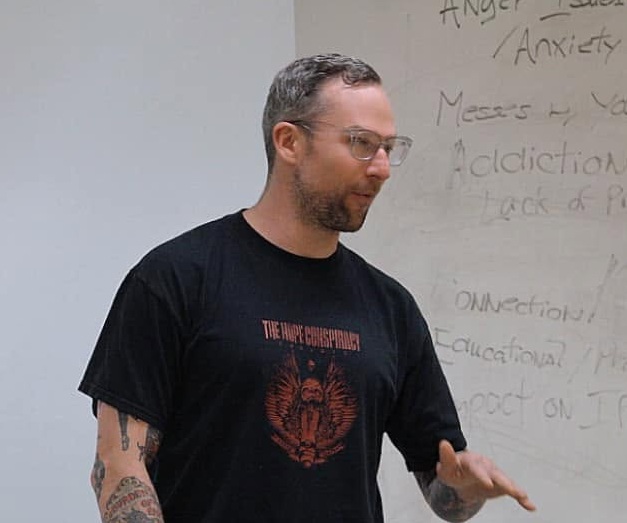
I was ripe with anticipation the morning Tyler Short came to talk to the IU Indianapolis “Rhythm and Revolution – Music and Social Change” class. I was delighted when he agreed to come in the first place. For virtually all of the semester, our professor Trev had alluded to this mysterious thing I was involved with called “hardcore”. Finally, someone could come in and put this mystery to bed. Tyler Short is one of the smartest and most well-spoken people I know. Only Tyler could intellectualize something so seemingly anti-intellectual as hardcore music. In the aggressive image, harsh gatekeeping, and unpalatable sound, the genre turns many away. Maybe Tyler could put a new face to that for our class.
On the day Tyler presented, there were two other presentations prior to his. It seemed almost like the perfect hat trick – from a conservation (and marijuana legalization) activist and musician, into one of Indianapolis’ most prominent rappers, and finally into the long-time straight edge hardcore legend, Tyler Short. The placement felt almost perfect, and it felt like vital discourse on the topic was ready to take place. It felt like the ultimate capping off of our guest speaker days for this Spring ’26 semester at IU Indianapolis.
Tyler’s presentation was able to do a lot with a little time. Not only was he able to connect what the other guest speakers talked about, but he gave the class the abridged history of punk and hardcore, and its connections to political responsibility. We learned about how Earth Crisis spiraled the vegan movement, or how the industry created the image of anarchy and punk, because they couldn’t sell a hammer and sickle behind the Sex Pistols. For a corner of the musical landscape that our course textbook addressed only a little, and which struggles to exist within the zeitgeist, Tyler was able to pack a lot of brand new information, and it seemed like it really stuck.
Not only did Tyler give us an overall history of hardcore, but also a personal one. Several things stuck, but his blunt statement of “where I was from in Kentucky, I could’ve just as easily been a Nazi” – not in a way of sympathizing, but articulating how easy it is to translate the rage of your world into something harmful. Instead, Tyler found hardcore, and then in turn found straight edge. This is where one of the most important social changes in hardcore lies. We often in class discuss the Gil Scott-Heron song and the central idea of “The Revolution Will Not Be Televised” – how a revolution of the mind must occur before the big one. I think that’s what Tyler was talking about here. Instead of channeling the rage of where he was from and the people around him into the hatred of others, hardcore created the most positive outlet possible.
Now while I was excited, I must admit the nerves were there too. Because for all the reasons above, hardcore is one of the most unpalatable music genres in sound and practice. The shows are violent. I’ve seen many broken noses, twisted ankles, and teeth flying in my short time. I can’t imagine what Tyler has seen. The music is fast, loud and unapologetic. I couldn’t help but feel nervous about how the class may react to it. Yet, Tyler worked his magic, and made hardcore something to think more deeply about. For all of its brutishness and chaos, hardcore can be extremely positive. It is self-expression at its peak, the most free music from commercial infringement , and I really think the Spring ’26 IU Indianapolis “Rhythm and Revolution” class was able to grasp that in Tyler’s presentation.
How Tyler Short Showed the Power of Punk and Hardcore Music
By Kaitlin Newhard
During the guest speaker presentation, Tyler Short talked about how punk and hardcore music changed his life and helped create social change. His story showed that music is more than just something people listen to for fun. Music can inspire people, bring communities together, and speak out against unfair treatment. Tyler’s experiences showed how punk and hardcore music gave people a voice and encouraged change in both personal lives and society.
One of the main things Tyler talked about was how music helped keep him on the right path. He said that without skateboarding and hardcore music, he may have ended up using drugs or getting involved in crime like many people he grew up around. Instead, music gave him something positive to focus on and a place where he felt accepted. He said hardcore culture helped save his life. This shows that music can guide young people and give them support when they need it most. For many people, music becomes a safe space during difficult times.
Tyler also talked about the straight edge movement. Straight edge means choosing to stay away from drugs and alcohol. He explained how bands like Minor Threat made this lifestyle popular in the hardcore scene. Young people were proud to make healthy choices and stand against what society expected from teenagers. Instead of feeling pressured to fit in, they created their own identity. This movement showed that music can promote strong values and positive decisions while helping people feel confident in their choices.
Another important topic Tyler discussed was veganism and animal rights. He said many people who supported groups like PETA first became interested through hardcore music scenes, especially fans of bands like Earth Crisis. These bands used their music to talk about protecting animals and helping the environment. Their songs encouraged fans to think about the choices they make every day. This shows that music can make people care about important issues and inspire action outside of concerts or shows.
Tyler Short also spoke about politics and fairness. He said punk and hardcore music taught him to question unfair systems and think about inequality. He talked about how some people blame others for problems in society instead of fixing the real issues. Tyler said the music scene helped him choose respect over hate. He also said it taught him to respect women more and become a better person. This shows how music can shape people’s beliefs and help them grow in a positive way.
Another way punk and hardcore created social change was through community. Tyler described hardcore shows as places where people support each other instead of trying to become rich or famous. Bands help each other, and fans come together because they care about the music and message. People at shows are there because they truly care, not because they want money or popularity. This creates a strong community based on passion, respect, and connection.
Overall, during his guest speaker visit to IU Indianapolis’ “Rhythm and Revolution – Music and Social Change” course, Tyler Short showed that punk and hardcore music can create social change by helping people make better choices, promoting healthy lifestyles, supporting activism, and building strong communities. His story proved that music can change lives and inspire people to make the world better. Even if punk and hardcore are not always mainstream, their message and impact are very powerful.