
By Anna Bullock
When I first signed up for “Rhythm and Revolution – Music and Social Change” at IU Indianapolis, I didn’t expect that one of the most meaningful perspectives I would hear would come from someone I already knew. I chose to interview my friend Nevaeh Parks because her story brings a different perspective than anything we’ve discussed in class, and she’s a big reason I developed a deeper appreciation for music and decided to take this course in the first place. Her journey through music, faith, and creativity has shaped her life in a way that also ended up shaping mine.
Nevaeh’s connection to music started long before she considered it a career. Growing up, she was constantly surrounded by it. Her father owned a Christian metal venue and her mother was a vocalist in a Christian rock band, so music was something she actively lived in. She spent time at shows, worked concessions, and saw how everything came together behind the scenes, which made her want to be on stage in some way. Once she joined band in middle school, she began learning clarinet and later expanded into other instruments, eventually earning first chair.
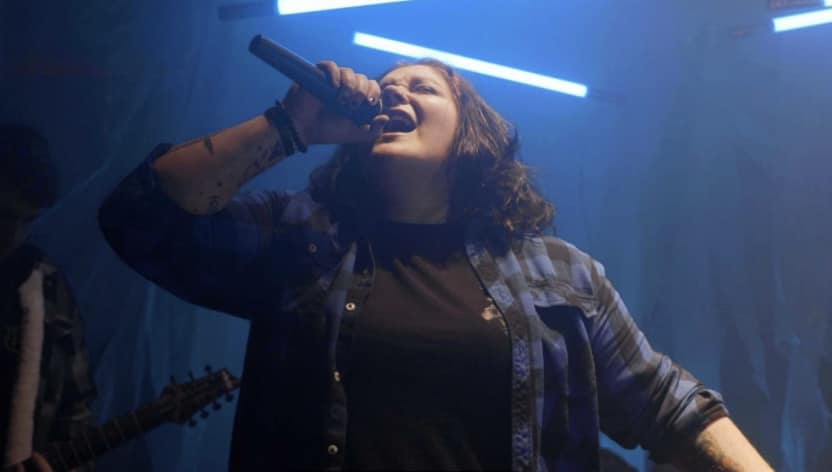
As she progressed through school, Nevaeh became especially passionate about marching band and discovered a love for leading and supporting other musicians, which sparked her interest in music education. By college, during the COVID-19 pandemic, she also began experimenting with guitar and songwriting, further developing her personal creative expression. What began as casual creativity turned more serious when she reached out to her friend Adam, a drummer she met through college pep band, and together they began building music from scratch using Discord, and shared documents and music software. From there, the project grew into a full band called Tempus Unum with Lincoln on lead guitar and Ryan on bass, and with the help of their mentor Becca, they were able to record and release songs like “Slander,” “Decay,” and “Relief.” What started as a small lockdown project became something real.
Because of her background, Nevaeh naturally became part of the Christian metal scene, but her experience in that space was more complicated than it might appear from the outside. While she met supportive people, she also described the environment as restrictive and judgment-heavy at times. “Once in a Christian band of any type, people expect you to be perfect,” she explained. That pressure made it hard for her and her bandmates, who were still young and figuring things out, to simply grow and be themselves. Over time, that tension led to a major shift. Instead of continuing to label themselves strictly as a Christian band, they chose to step away from that label and simply be a metal band made up of people who have faith, eventually becoming Taken Under. That decision came with pushback, but it also reflected something important about how Nevaeh sees music. As she put it, “I want to get down to the nitty gritty… to help people whether through my Christian lens or just my human lens.” To me, this quote from Nevaeh stood out because it shows her focus isn’t on fitting expectations, but on reaching people in an honest way.
That idea connects directly to what I see as her role in social change. By stepping outside of strict labels, Nevaeh opens her music to a wider audience instead of limiting it to a specific group. Her approach challenges the idea that music tied to faith has to stay inside certain boundaries, and instead shows that it can exist in a more open space where different perspectives can meet and still feel meaningful. That flexibility allows her message to reach people who might not normally engage with religious music, which is where her impact feels most real.
Another part of her story that stood out to me is her background in education. Nevaeh earned her degree in music education and worked as a K-8 teacher. As someone who also works in the education space, I connected with this part of her story the most. She talked about how teaching changed the way she views music, especially when it comes to students who don’t immediately see themselves as “music people.” Even students who said they didn’t like music still connected to certain artists or songs, which made her rethink her approach. She also saw how much of an impact music programs can have on students’ lives. As she shared, “I’ve seen students be saved from going down completely wrong paths because of music programs.” That
idea stuck with me because it shows how music can provide structure, community, and direction in ways people don’t always expect.
Now, Nevaeh continues her creative work as a tattoo artist, which at first might seem separate from music, but for her it’s just another form of expression. From my perspective, tattooing is just another way for her to tell stories and connect with people. While she occasionally gets to work on more meaningful, custom pieces, much of her work comes from walk-ins, so she’s constantly working on a wide variety of designs. Even in those quick interactions, she still focuses on creating a positive experience for her clients, something that shows up across everything she does.
When you look at music, education, and tattooing together, you can clearly see a focus on connection. Nevaeh isn’t just creating for the sake of art; she creates for herself, but also in a way that allows others to express themselves, process their experiences, and feel understood. What stands out most to me about her is not just what she does, but how she does it. She leads with empathy, honesty, and a willingness to grow even when things are uncertain or uncomfortable.
In a world where music is often treated as entertainment alone, Nevaeh’s story is a reminder that it can be something much more. It can be a form of connection, a tool for teaching, and even a way to create social change. Through her willingness to step outside of labels and expectations, she shows that impact doesn’t always come from being the loudest voice. It can come from being the most authentic one. And sometimes, change starts simply with creating something honest and letting it reach whoever needs it.