
By Kaila Sewer
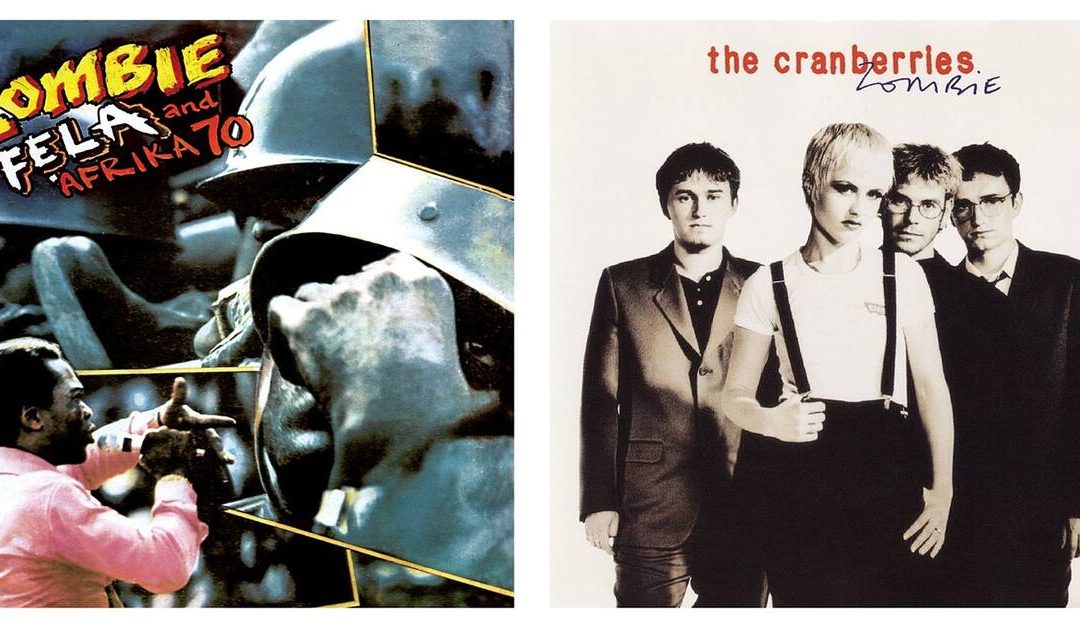
What is a soldier? Are they a slave to the whims of their government, or are they directly responsible for the violence inflicted on their people? “Zombie”, the title of two different songs performed by Fela Kuti and The Cranberries, equates the perpetrators of violence to mindless and aimless creatures, with both answering the question in drastically different ways. Although Fela Kuti and The Cranberries utilize imagery of the zombie as a method to critique violence and compliance, each song responds to distinct situations demonstrating how the same motif can serve completely different rhetorical purposes.
Fela Kuti’s “Zombie” (1976) differs from The Cranberries in that it provides a direct critique of the Nigerian military and authoritarian government in a scathing 12-minute song.
Nigeria itself is a large West African nation containing broad geography and a large population. Though, the country suffers greatly from governmental corruption. As a note, corruption exists in many societies and is not to be reduced to something that happens only in Nigeria. Many point towards British colonial rule as the cause of such widespread corruption in Nigeria. According to the American Historical Association, indirect rule, a concept that uses existing tribal structures and traditions as a baseline for establishing rules while English officials exercise power behind the scenes (2004). This system allowed for Britian to govern large territories with few actual men by encouraging selected locals to enforce policies. In theory, this system allows for efficient control, but it often created the perfect conditions for local authorities to operate without direct oversight. Thus, many systems of patronage or personal loyalty bloomed in place of transparent governance. The Council on Foreign Relations argues, though, that “At the time of independence in 1960, Nigerian leaders shared the vision of a huge, democratic, diverse nation that could give Africa and Africans a place at the international high table” (2018). This vision, unfortunately, was clouded by a fragile political structure born from colonial rule.
Following its status change as a republic in 1963, military rule of Nigeria lasted for decades with consistent armed conflicts. In 1966, the first Nigerian coup (Coup d’État) occurred in which a group of army majors overthrew the democratic government (BBC, 2016). What was supposed to be the end to ethnic rivalry and corruption only heightened the tensions between groups and led to increasingly restrictive military rulers. For 29 years, Nigeria experienced long periods of military governance (BBC, 2016).
One major event contributing to the political unrest in Nigeria is the Biafra Civil War, lasting from 1967 to 1970 and claiming the lives of millions. A generalized recounting of the events goes as follows:
Following Nigeria’s independence in 1963, increasing inequalities among its diverse ethnic groups, particularly between the Northern Region and the Igbo people of the Eastern Region, led to widespread dissatisfaction and unrest. A coup in January 1966 set off a power struggle, resulting in the declaration of independence by the Eastern Region as the Republic of Biafra on May 30, 1967. The Nigerian federal government responded with military action, marking the beginning of a brutal conflict characterized by severe humanitarian crises, including famine and mass displacement. Throughout the war, Biafra garnered international sympathy, leading to humanitarian aid efforts, while Nigeria received military support, notably from the Soviet Union. The war concluded on January 15, 1970, with Biafra’s surrender, resulting in the region’s reintegration into Nigeria. The aftermath saw significant suffering among the Igbo population, with millions affected by famine and the challenges of recovery, while international observers noted a lack of evidence for claims of genocide despite the humanitarian crisis. The war left a lasting impact on Nigeria’s socio-political landscape and continues to influence discussions around ethnic identity and national unity in the region (EBSCO, 2023)
This war, full of violence and abject cruelty, further reinforced the ethnic tensions that had been festering in Nigeria.
Since the year 1966, a total of eight military coups has been organized in Nigeria with the final coup occurring in 1993. Throughout that period, Kuti, born in 1938 as Olufela Olusegun Oludotun Ransome-Kuti, experienced much of this political unrest first-hand. Kuti, in the 70’s and 80’s, created politically charged messages establishing himself as “political dissident” popularizing the Afrobeat genre as one making politial and cultural statements” (Biography, 2020). Through Afrobeat, Kuti created music that included jazz, funk, and traditional West African rhythms producing deeply political but highly danceable tracks. His music, though, speaks to his personal experiences as a witness and a victim of governmental oppression and violence throughout Nigeria. Following the bloodless coup of 1975 in which Colonel Namvan Garba and his allies removed General Yakuba Gowon as chief of state commander and announced that Brig O. Obasanjo would be named chief of staff at Supreme Headquarters (New York Times, 1975), political instability remained at the forefront of Nigeria’s government.
During this era, Kuti released his seminal track “Zombie” which mocked Nigerian soldiers, portraying them as mindless brutes. Lyrics for the song include:
Zombie o, zombie (Zombie o, zombie)
Zombie o, zombie (Zombie o, zombie)
Zombie no go go, unless you tell am to go (Zombie)
Zombie no go stop, unless you tell am to stop (Zombie)
Zombie no go turn, unless you tell am to turn (Zombie)
Zombie no go think, unless you tell am to think (Zombie)
Tell am to go straight
A joro, jara, joro
No break, no job, no sense
A joro, jara, joro
Tell am to go kill
A joro, jara, joro
Tell am to go quench
A joro, jara, joro
No break, no job, no sense
A joro, jara, joro
Go and kill! (Joro, jaro, joro)
Go and die! (Joro, jaro, joro)
Go and quench! (Joro, jaro, joro)
Put am for reverse! (Joro, jaro, joro)
Joro, jara, joro, zombie wey na one way
Joro, jara, joro, zombie wey na one way
Joro, jara, joro, zombie wey na one way
Joro, jara, joro, zombie wey na one way
Joro, jara, joro
Attention! (Zombie) Quick march! Slow march! (Zombie) Left turn! Right turn! (Zombie) About turn! Double up! (Zombie) Salute! Open your hat! (Zombie) Stand at ease! Fall in! (Zombie) Fall out!
Fall down! (Zombie)
Get ready!
Halt!
Order!
Dismiss! (Kuti, 1976)
This work, performed by Fela, relies on repetition and military language in the construction of its motif, the zombie. Kuti mimics military cadence with his use of “A joro, jara, joro”, which translates roughly to “Left, right, left”, a common marching cadence that sets the pace and rhythm for troops. The repeated declaration that a “zombie no go think unless you tell am to think” frames soldiers as beings stripped of autonomy and sense, only acting when told to do so. In this sense, the “zombie” metaphor is wielded by Kuti as a rhetorical device that taunts the obedient and corrupt military. It’s clear, with the way Kuti portrays them, the soldiers are not heroes but instruments of oppression and violence with no moral compass of their own.
It is important to note that the language Kuti uses reflects a desire to communicate in mass with the people of Nigeria. According to Ethnologue, the country is home to about 223,805,000 people and 520 indigenous languages (Ethnologue, n.d.). Much of the song is spoken in Nigerian Pidgin English, with Pidgin being defined as “A language containing lexical and other features from two or more languages, characteristically with simplified grammar and a smaller vocabulary than the languages from which it is derived, used for communication between people not having a common language; a lingua franca” (BBC, 2016). Pidgin, a widely understood language, crosses ethnic boarders and divides that Fela attempts to reach with his song. This allows the song to extend beyond elite circles and into the communities plagued by the very systems that Kuti critiques. With the call-and-response nature of this song, political criticism becomes participatory, encouraging the listener to actively engage with Kuti’s messaging rather than passively absorbing it. His rhetorical strategy does more than condemn authoritarianism; it invites his audience to share their voice and their frustrations.
This song, however, did not go unnoticed by the Nigerian military government. Following its release, the tensions between Kuti and the government had escalated towards outright violence. In 1977, Kuti’s communal compound, called Kalakuta Republic, was attacked by 1,000 soldiers where his mother was subsequently thrown from a window and killed (Smith, 2011). This violent retaliation accentuated the threat that an unchecked authoritarian regime posed towards its people. But it also outlined how powerful music could be and the perceived threat of Kuti’s “Zombie”.
Yet, while Kuti uses satire to critique soldiers who “no go go, unless you tell am to go”, the same motif appears decades later in a completely different context. In 1994, the rock band The Cranberries released their own song, “Zombie”. Both works inherently rely on imagery of mindless undead as a way to comment on violence with them differing in their rhetorical situation and environment.
The Cranberries, rather than confronting dictatorship directly, grew up in a conflict in Northern Ireland called The Troubles. The Troubles is described by the Imperial War Museums as:
The Troubles is a term used to describe a period of conflict in Northern Ireland that lasted about 30 years. The Troubles began in the late 1960s until the Good Friday Agreement in 1998. However, the origins of the Troubles can be traced back hundreds of years. At the beginning of the 17th century, the Plantation of Ulster settled Protestants from lowland Scotland and the North of England. This caused a sectarian split in the population of the province; something that still resonates today and fed into the Troubles. Catholics predominantly consider themselves Irish and hold nationalist views – they want an independent Ireland free from British control. Protestants identify largely as British and unionist, meaning they wish to remain linked to the United Kingdom… The Good Friday Agreement was signed on 10 April, 1998. It was the culmination of talks between unionist parties, the political wings of both the UVF and UDA, Sinn Fein and the British
Government. The agreement created a plan for a power-sharing Northern Ireland
Assembly and outlined plans for future relationships between Ireland and Britain. It was approved the following month by a referendum in Northern Ireland and Ireland. Elections took place in June and it formally took power in December 1999. The Good Friday Agreement can be viewed as marking the end of The Troubles (Imperial War Museums, n.d.)
This conflict, between the nationalist and unionist groups, led to terrorism, shootings, bombings, and increased violence. It produced, in essence, a cycle of generational trauma that affected communities across Ireland. The band, comprised of Dolores O’Riordan, Noel Hogan, Mike
Hogan, and Fergal Lawler, are all Irish natives who grew up during the turmoil of The Troubles.
The catalyst for the production of their “Zombie” was the 1993 Warrington Bombings in Warrington, England. On March 20, 1993, the IRA (Irish Republican Army) hid two bombs which then exploded in Warrington killing two children and injuring 54 (BBC, 2024). The attack deeply affected the band’s lead singer, O’Riordan, telling Vox magazine that “I remember seeing one of the mothers on television, just devastated, I felt so sad for her, that she’d carried him for nine months, been through all the morning sickness, the whole thing and some… prick, some airhead who thought he was making a point, did that” (Savage, 2018). The weight of having witness such mindless killing directly influenced the writing of “Zombie” and the way in which the message of the song was framed.
The lyrics of the song emphasize the grief and frustration of their lead singer, referencing generational conflict throughout the song. Lyrics for The Cranberries “Zombie” include:
Another head hangs lowly
Child is slowly taken
And the violence caused such silence
Who are we mistaken?
But you see, it’s not me, it’s not my family
In your head, in your head, they are fighting
With their tanks and their bombs, and their bombs, and their guns
In your head, in your head, they are crying
In your head, in your head
Zombie, zombie, zombie
What’s in your head? In your head?
Zombie, zombie, zombie, oh … Another mother’s breaking
Heart is taking over
When the violence causes silence
We must be mistaken
It’s the same old theme since 1916
In your head, in your head, they’re still fighting
With their tanks and their bombs, and their bombs, and their guns
In your head, in your head, they are dying
In your head, in your head
Zombie, zombie, zombie
What’s in your head? In your head?
Zombie, zombie, zombie (The Cranberries, 1994)
Notable lines such as “It’s the same old theme since 1916” point towards the longer historical conflict, The Troubles, that caused the death of those children. That specific line references the Easter Rising, a revolt launched in 1916 against British rule (National Army Museum, n.d.). This event serves as a sort of symbol of Irish independence and resistance. Using this historical moment acts as a conduit of a much larger point, that contemporary violence tied to grievances of the past serves no one and only ends in death. The Cranberries, in this case, frame the zombie as a metaphor for societies trapped in mindless cycles of violence.
The Cranberries, though not the victims of physical violence, faced increased scrutiny following the songs’ release. At the time, criticism was sent towards the band accusing them of taking sides in the conflict, The Troubles (Peacock, 2025). Even their fellow countrymen, namely the Northern Irish band Schtum, are on record critiquing the song. Schtum frankly told Melody Maker, “She’s from Limerick, what the fuck would she know?” (Brannigan, 2023). This criticism reflects exactly how delicate this conflict had become even in the 1990s. Any cultural commentary, even one as bipartisan as “Zombie” risked ridicule and interpretations of choosing sides. While navigating such an environment, lead singer O’Riordan doubled down on the band’s stance stating that “I don’t care whether it’s Protestant or Catholic, I care about the fact that innocent people are being harmed. That’s what provoked me to write the song… it doesn’t name terrorist groups organizations. It doesn’t take sides. It’s a very human song” (Peacock, 2025).
The rhetorical shift between the two songs demonstrates where responsibility is placed. In Kuti’s “Zombie”, the target of ridicule and critique is clear: the soldiers who follow orders without question or remorse at the expense of their citizens. Alternatively, The Cranberries direct their critique towards the cycle of violence itself. The repeated refrain, “In your head, in your head, zombie” suggests to the audience that the true source of violence lies within humanities’ inability to recover from generational traumas and grievances. The zombie, in this case, is a representation of people mentally trapped by their beliefs and being unwilling to see beyond them.
Ultimately, both songs show how the zombie motif functions as a powerful rhetorical device in regard to politial activism. In Nigeria, Kuti utilizes the image to critique soldiers who enforce corrupt authoritarian governmental structures with no dissent. In Ireland, The Cranberries use the same image, condemning the continuation of generational violence while emphasizing the impact it has on innocents. Separated by geography, genre, and context, both works still manage to reveal a humanitarian concern with violence and its ability to strip individuals of compassion.
While framing the perpetrators of violence as zombies, each artist challenges their listeners to confront the systems that keep violence present in their communities.
Works Cited
Brannigan, Paul. “‘A View of Political Violence in Northern Ireland so Simplistic That Its Lyrics
Could Have Been Scrawled with a Crayon’: Why the Cranberries’ Zombie Is the Worst Song Ever Written about ‘the Troubles.’” Louder, Louder, 26 Sept. 2023, www.loudersound.com/features/why–the–cranberries–zombie–is–the–worst–song–everwritten–about–the–troubles.
“Easter Rising.” National Army Museum, www.nam.ac.uk/explore/easter–rising. Accessed 15 Mar. 2026.
“England’s Indirect Rule in Its African Colonies.” American Historical Association, 1 May
2004, www.historians.org/resource/englands–indirect–rule–in–its–african–colonies/.
“Excerpt: Nigeria: What Everyone Needs to Know.” Council on Foreign Relations, Council on
Foreign Relations, www.cfr.org/excerpt–nigeria–everyone. Accessed 15 Mar. 2026.
“Fela Kuti Biography.” The Biography.Com Website, A&E; Television Networks, 2 Apr. 2014, www.biography.com/musicians/fela–kuti.
“Gowon Ousted in Nigeria; Coup Ends Nine‐Year Rule (Published 1975).” The New York Times, The New York Times Company, 30AD, www.nytimes.com/1975/07/30/archives/gowonousted–in–nigeria–coup–ends–nineyear–rule–gowon–deposed–as.html.
“How First Coup Still Haunts Nigeria 50 Years On.” BBC News, British Broadcasting
Corporation, 15 Jan. 2016, www.bbc.com/news/world–africa–35312370.
“Nigeria Languages, Literacy, & Maps (NG) | Ethnologue Free.” Ethnologue, Ethnologue, www.ethnologue.com/country/NG/. Accessed 15 Mar. 2026.
“Nigeria-Biafra Civil War Ends: History: Research Starters: EBSCO Research.” EBSCO, EBSCO Information Services, 2023, www.ebsco.com/research–starters/history/nigeriabiafra–civil–war–ends.
Peacock, Tim. “‘Zombie’: The Story Behind The Cranberries’ Deathless Classic.” uDiscover Music, Universal Music Group, 19 Sept. 2025, www.udiscovermusic.com/stories/thecranberries–zombie–song/.
“Pidgin – West African Lingua Franca.” BBC News, British Broadcasting Corporation , 16 Nov. 2016, www.bbc.com/news/world–africa–38000387.
Savage, Mark. “The Tragedy That Inspired Zombie – the Cranberries’ Biggest Hit.” BBC News, British Broadcasting Corporation , 16 Jan. 2018, www.bbc.com/news/entertainment–arts42702781.
“Warrington IRA Bombing: Dad Vows to Keep Bringing People Together.” BBC News, British Broadcasting Corporation , 20 Mar. 2024, www.bbc.com/news/uk–england–merseyside68606047.
“What You Need to Know about the Troubles | Imperial War Museums.” Imperial War Museums, Department for Culture, Media, and Sport, www.iwm.org.uk/history/coldwar/the–troubles/what–you–need–to–know–about–the–troubles. Accessed 15 Mar. 2026.