
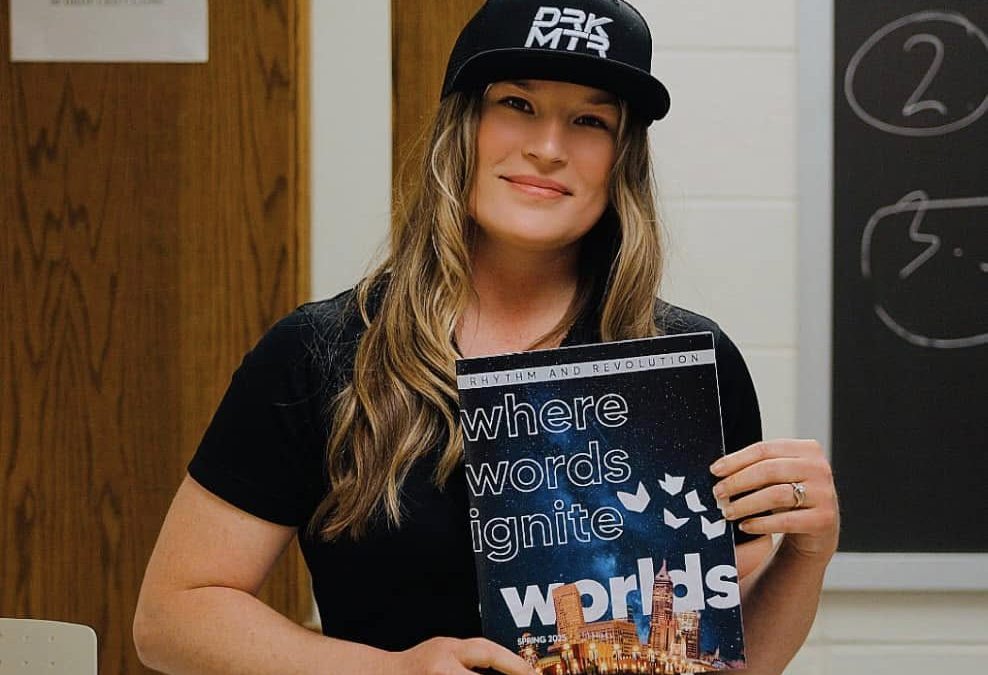
By Ava Garza
Alicia Tucker is a jack of all trades. Spanning from working on Indiana’s Norml group fighting for cannabis legalization in Indiana, to being part of the band IndyCa, being the Chief Content Advisor for Light Matter, and the new owner of the Metamora Castle. Alicia Tucker’s career and personal journey reflect a rare combination of creative energy, entrepreneurial drive, and community-centered vision.
What distinguishes Alicia Tucker is not any single role, but the way her pursuits reinforce one another. Her marketing background supports her entrepreneurial ventures; her music informs her vision for cultural programming; her advocacy reflects a commitment to shaping communities as well as participating in them. Based for many years in Indianapolis before relocating to rural southeastern Indiana, Tucker has built a multifaceted identity: musician, marketing strategist, advocate, and now co-owner of one of the state’s most unusual historic properties, the Metamora Castle. Across industries and roles, her work consistently intersects culture, storytelling, and place-making.
Music has remained a constant thread throughout Tucker’s life. As a member of the band Indyca, she has contributed to Indianapolis’s independent music scene, blending performance with community engagement. While details of the band’s full discography and reach are more localized, Tucker’s identity as a musician informs much of her broader work.
In addition to her creative pursuits, Tucker operates in the digital marketing space as part of Light Matter, a company specializing in online promotion, web strategy, and brand development. The firm focuses on helping businesses expand their digital presence through tools such as search engine marketing and targeted advertising. As a content advisor, Tucker contributes to shaping brand narratives and digital strategies. This expertise is directly reflected in how she documents and promotes the castle restoration project; leveraging social media, video platforms, and storytelling to build an audience around the process. Her ability to merge marketing strategy with authentic narrative has become a defining strength, allowing her to turn projects into ongoing, public-facing journeys rather than static outcomes.
Tucker’s work also extends into advocacy, including her involvement with NORML (the National Organization for the Reform of Marijuana Laws). As a board member, she participates in efforts to influence policy, promote education, and support reform initiatives related to cannabis legislation. This role highlights another dimension of her professional identity: civic engagement. Whether through advocacy, local economic development, or creative programming, Tucker consistently operates at the intersection of individual initiative and broader social impact.
Tucker’s latest creative project has been the purchasing and restoration of the Metamora Castle. In an interview with the Brookeville American Tucker stated, “After being in Indy for 20 years, it was like we forgot what communities like this feel like.” Her move from Indianapolis to Metamora illustrates a broader shift, from participating in established creative ecosystems to actively building new ones. In her own reflections, the transition has also carried a personal dimension, offering a slower pace and stronger sense of connection than city life provided.
Today, Tucker is perhaps best known as co-owner and visionary behind the revival of Metamora Castle. Situated on a 40-acre hilltop overlooking the Whitewater Valley, the site is being transformed into a multi-use venue with ambitions that extend far beyond private ownership. The restoration effort is both practical and symbolic. Structurally, the castle required significant work, including mold remediation, roofing repairs, and interior stabilization. At the same time, Tucker has emphasized preserving the building’s original character while adapting it for modern use. The future for the castle includes the following and even more: a wedding and event venue, hosting live music performances and festivals, hosting retreats and cultural programming, and forging and nurturing partnerships with local artisans and businesses.
Alicia Tucker
By Leyla Redmon
Alicia Tucker from the regional reggae band IndyCa came as a guest speaker for this Spring’s IU Indianapolis “Rhythm and Revolution” class. In this class she was talking about how she enjoyed taking similar classes during her time at the university (several with Prof. Trevor Potts) and to value success. She started off by asking the class what we think being successful means. For Tucker, being successful is finding your purpose and what makes you happy every day. “I had a mentor tell me a long time ago, you can work really hard for yourself, or you can work really hard for someone else. Either way you’re going to be working really hard, so do what you love.” I felt like this was a very inspirational quote she shared. Tucker feels like in the pollical sense there often seem to be issues that many don’t feel like they have much control over, but central to her message during her visit was to help us realize that we do, in fact, when we raise our voices, powerfully and strategically. Tucket stresses that talking to our legislators in order to make change is key, especially in that Indiana is a not a ballot initiative or referenda state. She explains that it means we don’t have the ability to directly vote on certain issues. That’s means that people cannot come together and make laws to vote on. Indiana is extremely limited on what we can vote for, and Alicia wants to see change in that. Alicia mentions that it is very important that we know who our representative is. Writing them a letter and talking about issues are important steps in initiating change important to citizens. We also learned from Alicia that corporations often influence political decisions, and that, says she, is a big problem. “What does this mean for Indiana?” Tucker asks. We learned that lobbying is very crucial in Indiana when people are organizing and rallying, they have to have very loud voices, and that can be very expensive. Alicia explains that “this is why it is important to get in front of your community.” She mentions that as we are progressing and getting into our professional careers, community is powerful. “Voting matters,” she stresses, “but in Indiana it is not enough.” She mentions that we have an social obligation to hold our representatives responsible because they work for us, and if we don’t talk to them about a problem us as citizens have, then we are not using our voices as powerfully as we could.
During her visit, Alicia also offered advice to the next generation on business in addition to music and politics, emphasizing the importance of staying open to “pivoting.” “There are going to be some days things are thrown at you, especially if you own your business or in media. Knowing when to change and make a shift, because we only have so much energy, (is key). We are like, oh, we have to put a hundred percent into something. That’s not real life. You have a hundred percent that you have to give to multiple things so don’t be a afraid to pivot.”
Outside of music, Alicia also puts her energies into issues surrounding data centers because she wants clean water. Alicia bought 40 acres in Metamora and partnered with organizations, renovated a castle in the area to try to build the area back up and bring money into the area. Alicia very passionate, and I chose to write an article on her presentation because it was very informational and was impressed with the dedication of each topic discussed.
ALICIA TUCKER
By Isabel Blaney
During her recent visit as a guest speaker to the IU Indianapolis “Music and Social Change” class, Alicia Tucker put the revolution in our “Rhythm and Revolution” course, and I have nothing but great things to say about her.
Alicia came in with a very high, almost frantic energy about her. Her high levels of passion transferred over to high energy which I thought was very cool to see how her passions affect her in real time. Alicia barely spoke about her music, and instead took the entire portion of her presentation to talk about social change. I admired this about her greatly. She barely took any time to plug herself or further her music career; she just wanted what she thought was best for the young minds. Alicia was determined to inspire change, and I admired that about her. She was selfless, and truly passionate for change which I thinks makes her a true social change musician, maybe even more than some of “the greats” that we studied in our class.
Alicia talked about how to get in touch with your representatives and senators. A lot of this information I already knew due to my political work background. However, when Alicia asked the class if they knew who their representative was, and I was the only one, I saw the change she was making. I view these resources for change like second nature because I have always been so exposed to them. Alicia is making change by providing young minds with the tools they need to make that change. Alicia could have sat in our class and told us how we should think like her, plugged her music, and left. But she pushed the class to be engaged, she taught the class easy ways to stand up for what they believe in. She even gave insight on how the Indiana political system worked. She shared her views without shaming and pushing them onto us. She had a very welcoming demeanor. I believe that she would have a conversation with people who thought differently than her instead of spread hate towards them.
In a world so politically divided, I think it is so important to have people like Alicia in the world. She is making an effort for change without getting paid to do so. She cares about the learning minds and she proves it by providing tools and teaching about facts rather than opinions. Alicia Tucker is really making a difference in the community for young minds. She has so much more insight than just music and I think her ability to teach needs to be shared.