
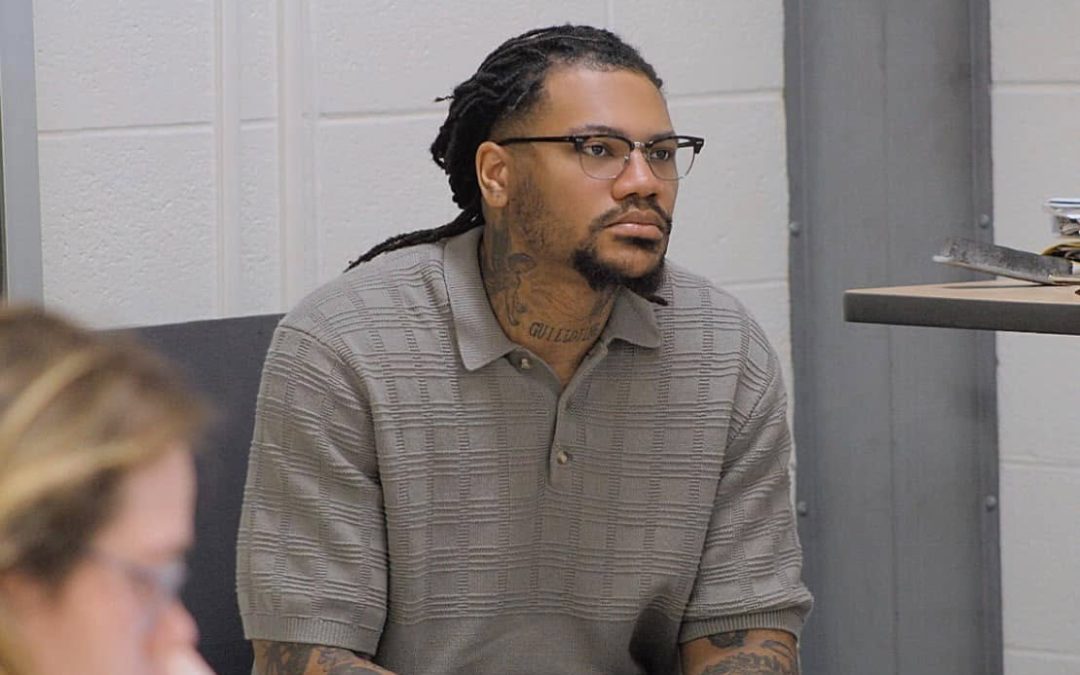
Words by Olamide Gbemisola, Dakota Beaty and Charlie Stutz
By Olamide Gbemisola
In a music industry that often rewards conformity, Drayco McCoy has spent over a decade doing the opposite. The Indianapolis-based rapper, producer, graphic designer, and podcaster have built an entire creative world on his own terms, releasing more than 33 projects independently, hosting a platform dedicated to uplifting local artists, and navigating a deeply personal journey through sobriety, all while staying rooted in the community that shaped him. To understand Drayco McCoy is to understand that social change does not always arrive through protest songs or viral moments. Sometimes, it shows up quietly through consistency, vulnerability, and an unwavering refusal to give up on where you come from.
McCoy was born and raised in Fort Wayne, Indiana, before relocating to Indianapolis, where he would eventually become one of the city’s most prolific and recognizable independent voices. From the beginning, his approach to music set him apart. Rather than chasing a mainstream sound, he experimented freely — blending elements of hip-hop with punk and rock influences, creating something that felt raw and unpolished in the best possible way. His sound was never meant to fit neatly into a box, and that refusal to conform became one of his most defining statements as an artist.
What makes McCoy’s story particularly compelling in the context of social change is not just the music itself, but also everything he built around it. As an independent artist, he has been outspoken about the challenges of surviving in the music industry without major label support. He has used his platform to name those challenges directly, pushing back against a system that often overlooks artists who do not fit a commercial mold. In doing so, he has become a quiet advocate for a different kind of music economy, one that values artistic integrity, community investment, and DIY ethics over profit margins and streaming numbers.
Perhaps the clearest expression of that advocacy is his podcast, originally called Bleedin’ Out with Drayco McCoy and later rebranded as The Floor Breakers Podcast. Created to shine a light on independent artists and small business owners across Indiana, the show operates with a simple but powerful mission: to tell the stories of people who are doing real creative work, often without recognition or resources. McCoy hosts, produces, records, mixes, and designs the artwork for the podcast himself, a one-man operation that mirrors the same DIY spirit he champions in his music. He has described the podcast to prove that it is possible to build something meaningful from the ground up, and to inspire others who might not believe that kind of life is available to them.
The stories McCoy tells on his podcast reflect a larger truth about creativity and community in cities like Indianapolis. For many young artists in the Midwest, there is a persistent sense that real opportunities exist somewhere else, in New York, Los Angeles, or Atlanta, and that staying home means falling behind. McCoy’s work challenges that assumption directly. By centering Indiana voices and Indiana stories, he is making a cultural argument: that the Midwest is not a launching pad to leave, but a place worth building in. That argument may be one of his most significant contributions to social change because it shifts the way people in his community see themselves and their city.
McCoy’s sobriety journey adds another layer of meaning to his public work. In a 2025 interview on the Conversation Piece Podcast, he spoke openly about his creative process and his recent decision to get sober, a conversation that resonated with fans and fellow artists alike. Sobriety is rarely a topic artists discuss with honesty and ease, particularly in a genre where substance use is often glamorized or normalized. By speaking candidly about his own experience, McCoy modeled a different kind of strength: the kind that comes from choosing yourself, even when the culture around you might push in another direction. That kind of openness is itself a form of social change, one person being honest in public makes it easier for others to do the same in private.
At over 33 projects deep into his career, McCoy’s output is staggering by any measure. Titles like World Domination, Half Dead Pariah, and Skull Island reflect an artist who takes his craft seriously and approaches it with relentless energy. His discography covers a wide emotional and sonic range, from hard-edged street rap to more introspective, experimental territory. Across all of it runs a thread of authenticity that his listeners respond to because it feels earned. He is not performing toughness or vulnerability; he is documenting a life being lived.
Beyond his own music and podcast, McCoy has become a connector within the Indianapolis creative community. He has used his platform to highlight other artists, from producers to painters, bringing attention to people who might otherwise go unnoticed. In a city that does not always get national coverage for its arts scene, that kind of community-building matters enormously. It creates networks, fosters collaboration, and keeps creative energy circulating locally rather than always flowing outward.
When Drayco McCoy visited as a guest speaker, what stood out most was not a single quote or moment. It was the overall picture of someone who had chosen a harder path and kept walking it anyway. He did not talk about social change the way an academic might, with theories and frameworks. He talked about making music when no one was listening, supporting other artists even when his own work demanded all his attention, and getting sober not because it was easy but because it was necessary. Those are not small things. They are the quiet, unglamorous building blocks of real change.
Music has always been one of the most powerful tools human beings have for making sense of the world and for challenging it. Drayco McCoy understands that, not as a talking point but as a lived practice. He makes music that reflects the full complexity of being human, builds platforms that amplify voices that often go unheard, and lives with an openness that invites others to do the same. In Indianapolis and beyond, he is proof that social change does not require a stage at a major festival or a record deal with a major label. Sometimes, it just requires someone willing to stay in their city, keep creating, and refuse to let the floor hold them down.
Drayco McCoy
By Dakota Beatty
When Drayco McCoy came in as a guest speaker, it didn’t really feel like a normal class that day. It felt more real and more personal. He didn’t try to act like a celebrity or anything—he was just honest about his life, his music, and what he’s been through. That’s what made people actually listen.
Drayco McCoy is an artist from Indianapolis, and a lot of what he talked about connects directly to where he’s from. He explained how growing up here shaped his mindset and his music. Instead of waiting for opportunities, he said he had to create his own. One thing that stood out was when he said, “Where I’m from, you have to build something out of nothing.” That really shows how much effort and independence it takes to come up in a city that doesn’t always get attention in the music industry.
His music reflects his real life and emotions. He doesn’t just make songs for fun or popularity—he makes them so people can relate. He talked about how important it is to be honest in your music, even when it’s uncomfortable. He wants people to actually connect with what he’s saying.
Another big thing he talked about was emotions. He was very open about the fact that being an artist isn’t always easy. There are a lot of ups and downs, and sometimes you have to deal with things internally while still trying to create. He said, “If I’m not being real in my music, then there’s no reason for me to do it.” That honesty is what makes his music different, because he’s not pretending to be something he’s not.
Besides music, Drayco McCoy also has a podcast called Bleedin’ Out. He uses it as a way to talk about real topics and also give other people a voice. He brings on other artists and talks about their experiences, struggles, and goals. He said, “It’s bigger than just me—it’s about creating space for everybody to have a voice.” That shows he’s not just focused on himself, but also on helping others get heard.
He also does a lot for the Indianapolis community. Instead of leaving to try and get famous somewhere else, he stays and works with people here. He supports other artists, collaborates, and helps build the local scene. One thing he said that really stood out was, “People think you have to leave your city to make it, but sometimes the real change comes from staying.” That shows he really cares about where he’s from and wants to see it grow.
Overall, Drayco McCoy’s message was about being real, staying true to yourself, and using what you have to make a difference. He showed that music isn’t just about entertainment—it can actually help people, tell stories, and bring a community together. His story proves that you don’t have to be famous to have an impact. You just have to be honest and willing to put in the work.
In the end, his visit made it clear that music can do more than just sound good. It can actually mean something. And through everything he does, Drayco McCoy is using his voice to make sure people feel heard and understood.
Drayco McCoy
By Charlie Stutz
“Don’t stop, and it will all work out eventually.” These are the words of a man who has released over 30 albums in less than 15 years, picked up photography and videography, started a clothing brand, expanded into multiple genres, and is a crucial piece of hosting Indianapolis’ biggest music festival every year, Chreece. When discussing the music scene in Indianapolis, it is hard to forget the all-around creative that is Drayco McCoy.
McCoy’s musical journey began about 15 years ago. The now Indianapolis citizen, originally from Fort Wayne, found himself passionate about the arts from a young age, whether he knew how it would work out or not. Originally a fan of poetry and writing, with credit to his aunt and uncle, as well as Lil Wayne’s ‘The Carter II’, McCoy discovered music was his true calling in the late 2000s after moving to the Indianapolis area. He calls the Fountain Square area home and credits it for growing his passion and understanding for the rather “underground” music scene that exists in Indianapolis. By 2013, McCoy had put together his first full body of work, a mixtape called ‘Grandisimo.’ Since then, McCoy has only grown as an artist and all-around creative.
Continuing his role in the Indianapolis hip-hop scene, McCoy finally was able to reap the fruits of his labor following the release of his album, ‘8-Ton Gorillia’ in 2017. The album featured the song ‘Bimmer.’ The track would go on to amass over 120,000 streams on SoundCloud alone and solidify its spot as the entryway to McCoy’s catalog. The 2016-2019 “SoundCloud Era” is when McCoy became a well-known name in the underground hip-hop scene. This era was responsible for some of hip-hop’s biggest names over the past decade, such as Juice Wrld, Lil Yachty, Lil Uzi Vert, Playboi Carti, and McCoy, who had the perfect combination of talent and skill to get his foot in the door. Capitalizing on the success of ‘8-Ton Gorilla’ in 2017, McCoy released ‘Baby Guillotine Lost Files’ in 2018, which featured the song ‘Relapse.’ The song was previously released on the Elevator YouTube channel, one of the most well-respected pages in hip-hop, in late 2016, but was never released on streaming services until 2018. ‘Relapse’ has since become one of McCoy’s most successful and recognizable songs, with over 400,000 streams on SoundCloud.
Although these songs introduced much of his core fanbase, McCoy has had no fear throughout his career in stepping into different genres, scenes, and soundscapes. Most notably, his feature verse on Omar Apollo’s ‘Algo’ from 2017. Apollo, a Mexican-American R&B and Pop artist from Hobart, Indiana, had met McCoy at a house show where the two performed together, and a connection was built. The connection between the two led to the track ‘Algo’, a contemporary fusion between the R&B sounds that shaped North-West Indiana and the grimy sounds of the Indianapolis hip-hop scene at the time. The song has remained popular with both of their catalogs, amassing over five million streams on Spotify alone. This collaboration and step into a new genre is perhaps one of the most influential moments in McCoy’s career thus far.
Starting in early 2022, McCoy found himself with the opportunity to do something rather unheard of: become one of the most prominent faces in the Indianapolis hardcore scene. Being the all-around creative that McCoy is, this was no risk as success was all but guaranteed. McCoy is now working on what he describes as “RapCore,” the traditional soundscapes of hardcore music mixed with the vocal performance of rap and hip-hop. McCoy himself has credited a lot of his career developments to the hardcore scene that has been quietly erupting in Indianapolis, stating that “hardcore shaped my live performances.” During his transition period, this influence was evident. At a 2022 show with a fellow well-known Indianapolis musician, Midwxst, McCoy performed the entirety of his primarily hip-hop set with a live band behind him. The hardcore influence has continued to guide McCoy’s recent career ever since. McCoy is now the frontman in a hardcore band called Inner Peace. The group combines the raw sounds of hardcore and punk with McCoy’s rap and hip-hop vocal delivery. The sound is one of a kind and has led to yet another surge in Drayco McCoy’s name in the Indianapolis music scene.